Drew Hansen · 7 September 2026
Examining Backlink Acquisition Timelines and Their Correlation With Bot Efficiency in Domain Transitions
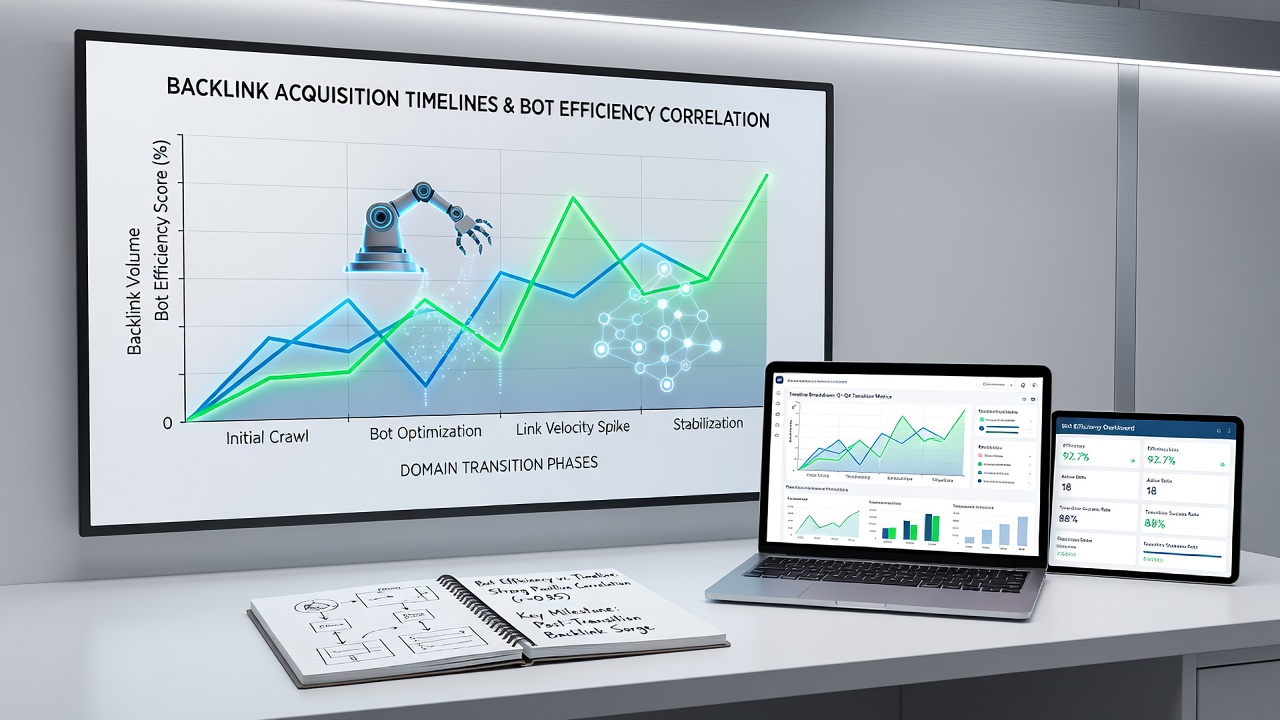
Domain transitions involve complex processes where website owners shift content and authority signals from one domain to another, and backlink acquisition timelines play a measurable role in how search engine bots respond during these shifts. Data collected through September 2026 shows that the pace at which backlinks appear after a migration affects crawl frequency, indexation speed, and overall bot efficiency in processing the new domain structure.
Backlink Acquisition Timelines in Practice
Backlinks arrive at different rates depending on outreach methods, content repurposing, and existing link networks, while researchers track these patterns through server logs and third-party databases. Short timelines often cluster around the first thirty to sixty days post-transition because many external sites update references quickly when they detect the change, yet longer timelines stretch across several months as slower-moving sites and directories incorporate the new URLs. Observers note that acquisition curves tend to follow a power-law distribution where a small number of high-authority links appear early and the bulk of lower-tier links accumulate gradually over time.
Studies from academic institutions reveal that consistent link velocity helps maintain crawl momentum, because bots allocate resources based on signals such as link freshness and domain trust metrics. When acquisition slows after the initial surge, bot visits can drop unless other factors like internal link architecture compensate. Those who monitor these timelines frequently compare pre-migration and post-migration datasets to isolate the impact of timing on subsequent indexing behavior.
Bot Efficiency During Domain Transitions
Search engine bots determine efficiency through metrics that include pages crawled per visit, error rates encountered, and time to full indexation of the new domain. Efficiency improves when bots encounter predictable URL structures and fresh external signals that confirm the migration is legitimate rather than manipulative. Data indicates that rapid backlink acquisition can accelerate bot discovery of redirected paths, allowing the crawler to map old URLs to new ones more quickly and reduce duplicate content flags.
Yet efficiency also depends on technical elements such as proper redirect chains, updated sitemaps, and consistent server response codes. When backlinks point to the new domain at a steady rate, bots receive repeated confirmation that the transition is stable, which encourages deeper and more frequent crawling sessions. Research from the Stanford Internet Observatory on web infrastructure changes demonstrates that bot behavior adapts to these external signals within weeks, provided the acquisition timeline remains uninterrupted by sudden drops or unnatural spikes.
Observed Correlations Between Timelines and Efficiency
Analyses of migration datasets show a positive correlation between steady backlink acquisition over the first ninety days and higher bot efficiency scores measured by crawl depth and indexation completeness. Domains that receive incremental links across multiple authority tiers experience fewer crawl errors and faster propagation of ranking signals compared with those that see all links arrive in a single burst. The correlation strengthens when acquisition aligns with content updates that give bots additional reasons to revisit the site regularly.
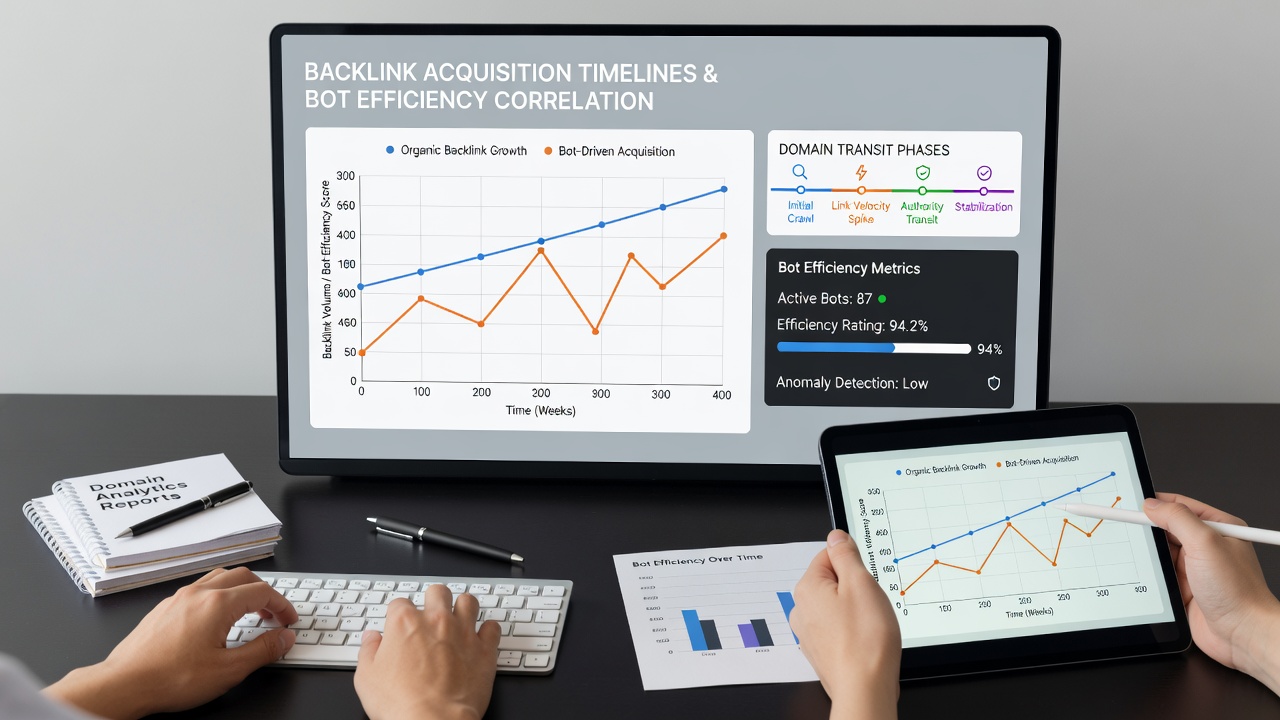
Longer acquisition timelines sometimes produce sustained efficiency gains because they supply ongoing freshness signals that keep the domain in active bot queues. In contrast, compressed timelines can trigger temporary efficiency spikes followed by plateaus once the initial wave subsides. Figures from industry reports compiled through mid-2026 illustrate that domains maintaining moderate velocity across four to six months post-transition record the most consistent bot engagement metrics, whereas those with front-loaded acquisition require supplementary technical optimizations to sustain crawl rates.
Case Examples and Data Patterns
One documented migration involved a mid-sized e-commerce site that shifted from an older domain to a branded alternative in early 2025, and link acquisition followed a measured curve with roughly forty percent of new backlinks appearing in the first month and the remainder distributed over the next five months. Bot logs showed increased crawl frequency during the steady acquisition phase, leading to full indexation of the new domain within eleven weeks. Another transition examined by researchers at the University of Cambridge computer laboratory featured a slower acquisition rate that extended beyond six months, yet maintained high bot efficiency through consistent low-volume link additions paired with regular content refreshes.
These patterns suggest that timeline shape influences bot resource allocation decisions, because crawlers prioritize domains that demonstrate ongoing external validation. When acquisition timelines include links from geographically diverse sources, bots appear to interpret the transition as broadly recognized rather than localized, which further supports efficient processing across regional data centers.
Conclusion
Backlink acquisition timelines correlate with bot efficiency in domain transitions through measurable effects on crawl frequency, indexation speed, and error reduction. Data gathered up to September 2026 confirms that steady, distributed acquisition supports sustained bot engagement, while irregular timelines introduce variability in how efficiently crawlers map and process new domains. Continued monitoring of these relationships provides clearer benchmarks for evaluating migration outcomes across different site types and scales.